
Silikonbasierte Narbenpflege der ersten Wahl – individuell auf Ihre Patienten abgestimmt |
Jede Narbe ist anders. Jeder Patient auch. Narbentyp, Lokalisation, Hautbeschaffenheit und Lebensstil beeinflussen, welche Behandlung am besten geeignet ist.1-3
Silikon wird in klinischen Leitlinien weithin als Therapieoption der ersten Wahl empfohlen - geschätzt für die einfache Anwendung und die Eignung für unterschiedlichste Narbentypen und Lokalisationen.2,4-7
Warum KELO-COTE®?
KELO-COTE® wird durch mehr als 10 klinische Studien belegt, die die Wirksamkeit in der Prävention und Behandlung hypertropher Narben und Keloide belegen.3,6-16
Der SILICLEAR®-Vorteil
Nicht alle Silikongele sind gleich. Die einzigartige SILICLEAR®-Technologie von KELO-COTE® vereint:
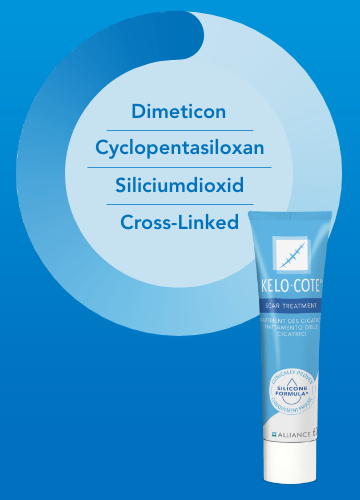
*Im Vergleich zu einer vergleichbare Formulierung ohne vernetzte Technologie
Praktische Darreichungsformen für die Bedürfnisse Ihrer Patienten
Geeignet für Kinder (ab 3 Monaten; Spray ab 12 Monaten), Erwachsene und Patienten mit empfindlicher Haut (Produkte ohne UV-Schutz) – so lässt sich die Behandlung individuell auf jeden Patienten abstimmen.
Literatur
1 Basson R and Bayat A. Skin scarring: Latest update on objective assessment and optimal management. Front. Med. 2022 9:942756.
2 Monstrey S, et al. Updated scar management practical guidelines: non-invasive and invasive measures. J Plast Reconstr Aesthet Surgery 2014;67(8):1017-25.
3 Kim SM, et al. Prevention of postsurgical scars: comparison of efficacy and convenience between silicone gel sheet and topical silicone gel. J Korean Med Sci. 2014;29(3): S249-53.
4 Gold MH, et al. Updated International Clinical Recommendations on Scar Management: part 2- Algorithms for Scar Prevention and Treatment. Dermatol Surg 2014;40(8):825-31.
5 Mustoe T. Evolution of Silicone Therapy and Mechanism of Action in Scar Management. Aesth Plast Surg (2008) 32:82-92.
6 Signorini M, et al. Clinical evaluation of a new self-drying silicone gel in the treatment of scars: a preliminary report. Aesthetic Plast Surg 2007;31(2):183-7.
7 Sepehrmanesh M. Scar Management: Observational study of 1522 patients using KELOCOTE® silicone gel. Kompendium Dermatologie 2006; 1: 30-32.
8 Chernoff WG, et al. The Efficacy of Topical Silicone Gel Elastomers in the Treatment of Hypertrophic Scars, Keloid Scars, and Post Laser Exfoliation Erythema. Aesth. Plast. Surg. 31:495500, 2007.
9 Stoffels I, et al. Influence of silicon spray on scar formation. Hautarzt 2010; 61: 322-338.
10 Steinstraesser L, et al. Pressure garment therapy alone and in combination with silicone for the prevention of hypertrophic scarring: Randomized controlled trial with intraindividual comparison. Plast Reconstr Surg 2011;128:306e.
11 Radwanski HN, Correa WEM, Refosco TJ, Pitanguy I. Silicone gel in plastic surgery scars: A prospective study. Rev Bras Cir Plást. 2010;25(3):428–433.
12 Capdevilaa EF, et al. Prevention of scarring after the excision of benign cutaneous lesions. Piel. 2007;22(9):421-6.
13 Grella R, et al. A useful method to overcome the difficulties of applying silicone gel sheet on irregular surfaces. International Wound Journal 2013; 185-188.
14 Medhi D, Sewal RK. Efficacy and Safety of an Advanced Formula Silicone Gel for Prevention of Post-Operative Scars. Dermatol Ther (Heidelb) (2013) 3:157–167.
15 Murison M, James W. Preliminary evaluation of the efficacy of Dermatix silicone gel in the reduction of scar elevation and pigmentation. J Plast Reconstr Aesthet Surg. 2006;59(4):437-9.
16 Spencer JM. Case series: Evaluation of a liquid silicone gel on scar appearance following excisional surgery - A pilot study. Journal of Drugs in Dermatology 2010; 9(7): 856-858.


